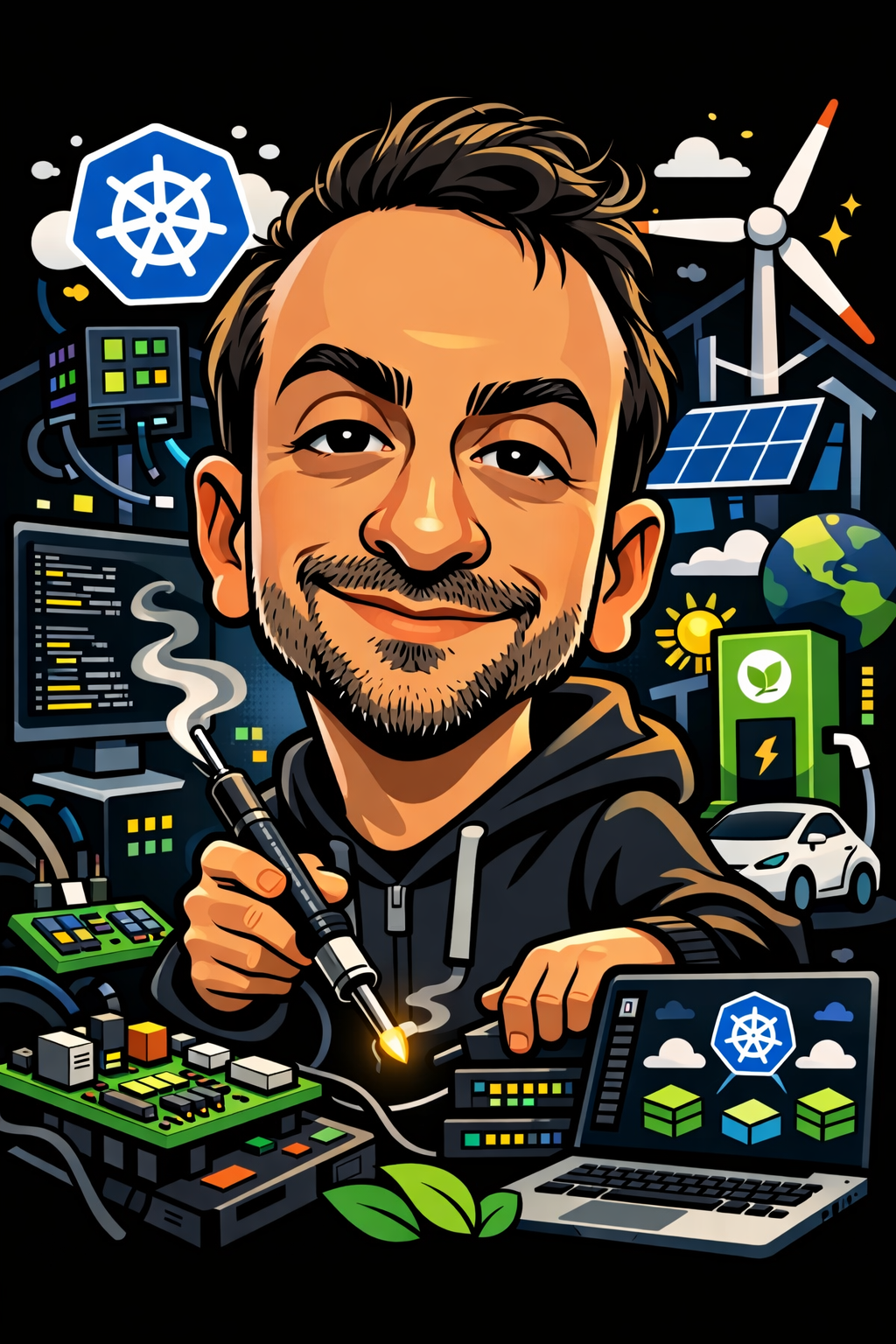
Open to roles: System · V&V · Cloud/DevOps Domains: Aerospace · Powertrain · Industrial
Luigi Cucciolillo
Senior Electronic Engineer · Validation & Verification · Cloud-native tooling
I am a Senior electronic engineer with a strong background in the design, validation, and industrialization of electronic systems for harsh environments.
My experience spans digital and power electronics, validation and verification, and mass-production testing across demanding industrial, automotive, and aerospace contexts.
Over the years, I have worked at the intersection of reliability, compliance, and scalability, covering the full product lifecycle from requirements definition and electronic design to validation strategy and production readiness.
Alongside hardware and system engineering, I am progressively deepening my focus on software engineering, DevOps, and cloud computing, focusing my journey into Kubernetes and modern orchestration platforms.
It is not just a cloud technology, but a foundational layer for building scalable and resilient systems.
I actively explore its application in domains closely aligned with my hands-on experience, such as Computer System Validation (CSV), IoT ecosystems and sensor networks, and autonomous edge computing for industrial automation, smart factories, autonomous vehicles, drone swarms, and large-scale infrastructure.
Experience
Role overview
System & Product Development Engineer
Lead Hardware Validation Engineer
Validation Engineer
Validation Engineer
System Test Engineer
Hardware Design Engineer
Trainee
Trainee
Volunteer / Sales & Employee Assistant — British Heart Foundation
Education & Training
Courses cards
Linux Foundation System Administrator
- Introduction to Cloud Infrastructure Technologies (LFS151) is a broad, entry-level course designed to provide a comprehensive overview of the technologies, concepts, and architectural patterns that underpin modern cloud computing. It is intended for system administrators, developers, and architects who are new to the cloud and need a structured framework to understand the rapidly evolving cloud-native landscape and evaluate which technologies best align with their organizational needs.
The course introduces the fundamental service models—Infrastructure as a Service (IaaS), Platform as a Service (PaaS), and Container as a Service (CaaS)—and explains how virtualization, containers, and orchestration technologies enable scalable and flexible infrastructure. Learners gain hands-on exposure to container fundamentals using Docker, along with conceptual grounding in microservices, container orchestration, and emerging execution models such as unikernels and serverless computing.
Beyond compute, the course explores software-defined networking and software-defined storage, highlighting how networking, storage, and observability are reimagined in cloud-native systems. It also covers essential DevOps practices and tooling, including CI/CD, configuration management, image building, logging, monitoring, distributed tracing, and service meshes, providing a holistic view of how modern cloud platforms are built and operated. Finally, the course addresses advanced and forward-looking topics such as IoT integration and operational best practices, helping learners understand both the opportunities and challenges of cloud adoption.
By the end of the course, participants develop a solid foundational understanding of cloud infrastructure and open-source cloud technologies, enabling them to make informed decisions, collaborate effectively across development and operations teams, and prepare for more specialized cloud and platform engineering paths.
- This class is designed for people who have little or no prior experience with cloud technologies. System administrators, developers, and architects new to the cloud can all benefit from the content covered in this class, especially if they are looking to evaluate which cloud technologies might be the best fit for their organization.
- In this course you will receive an overview of common cloud technologies, an introduction to Iaas, PaaS, CaaS, and learn about basic operations with containers and images using Docker command, software-defined networking and software-defined storage solutions, the skill sets needed to deliver next generation cloud, and the challenges of cloud technologies.
- You will walk away from this course with an understanding of cloud computing and the use of open source software to maximize development and operations.
- Chapter 1. Virtualization Chapter 2. Infrastructure as a Service (IaaS) Chapter 3. Platform as a Service (PaaS) Chapter 4. Containers Chapter 5. Containers: Micro OSes for Containers Chapter 6. Containers: Container Orchestration Chapter 7. Unikernels Chapter 8. Microservices Chapter 9. Software-Defined Networking and Networking for Containers Chapter 10. Software-Defined Storage and Storage Management for Containers Chapter 11. DevOps and CI/CD Chapter 12. Tools for Cloud Infrastructure: Configuration Management Chapter 13. Tools for Cloud Infrastructure: Build & Release Chapter 14. Tools for Cloud Infrastructure: Key-Value Pair Store Chapter 15. Tools for Cloud Infrastructure: Image Building Chapter 16. Tools for Cloud Infrastructure: Debugging, Logging, and Monitoring for Containerized Applications Chapter 17. Service Mesh Chapter 18. Internet of Things (IoT) Chapter 19. Serverless Computing Chapter 20. Distributed Tracing Chapter 21. How To Be Successful in the Cloud
- Introduction to DevOps and Site Reliability Engineering (LFS162) is a foundational course that provides a structured introduction to the principles, practices, and cultural shifts that underpin modern software delivery and reliable system operations. It is designed both for managers seeking guidance on how to initiate and lead organizational transformation, and for engineers who aspire to build a career in DevOps and Site Reliability Engineering (SRE).
The course explains how DevOps practices have reshaped software development and operations by breaking down silos, accelerating delivery cycles, and improving collaboration. It explores the role of cloud computing and container technologies, with Kubernetes as a central platform, in enabling scalable, resilient, and repeatable application deployments. Learners are introduced to the motivations and practical implementation of Infrastructure as Code, highlighting how infrastructure automation improves consistency, traceability, and operational confidence.
In addition, the course covers CI/CD pipelines and their role in delivering software safely and continuously, as well as the fundamentals of observability, including what to monitor, why it matters, and how observability supports system reliability. The final sections introduce Site Reliability Engineering, presenting SRE as a disciplined engineering approach to balancing feature velocity with system stability and reliability.
By the end of the course, participants gain a solid understanding of DevOps and SRE foundations, equipping them with the conceptual and practical knowledge needed to deploy and operate software systems with speed, resilience, and high reliability in modern cloud-native environments.
- If you are a manager looking for guidelines on how to start transforming organizations, and understand where to start, this course is for you. If you aspire to make a career in the world of DevOps and Site Reliability Engineering, this course is your starting point.
- In this course you will learn how DevOps is influencing software delivery, how cloud computing has enabled organizations to rapidly build and deploy products and expand capacity, how the open container ecosystem, with Kubernetes in the lead, is truly revolutionizing software delivery, and the why, what and how of writing Infrastructure as Code. The course also covers Continuous Deployment and Continuous Delivery (CI/CD), as well as the role played by observability systems, what to observe and why.
- Upon completion, you should have a good understanding of the foundation, principles, and practices of DevOps and Site Reliability Engineering, and have gained the knowledge and skills to understand how to deploy software with confidence, agility and high reliability using modern DevOps and SRE practices.
- Chapter 1. Welcome! Chapter 2. Introduction to DevOps and Site Reliability Engineering Chapter 3. Introduction to Cloud Chapter 4. Introduction to Containers Chapter 5. Infrastructure as Code Chapter 6. Continuous Integration/Continuous Delivery Chapter 7. Introduction to Observability Chapter 8. Site Reliability Engineering
Advanced Cloud Engineer IT Professional Program
- It has become extremely important for countless job roles in the technology industry to learn about containers, be they developers, quality assurance, operations, or DevOps.
- This Containers Fundamentals course will help you build a solid foundation on container technologies. After completing this course, you should be able to perform container and image operations with different container runtimes, manage network and storage (volumes) with containers, build and run multi-container applications with Docker, Docker APIs, etc.
- This course prepares you to work with containers to bundle an application with all its dependencies and deploy it on the platform of our choice, be it Bare-Metal, VM, Cloud, etc. Once you have learned the basics with the course, you will be able to take on more advanced topics, like Docker Swarm and Kubernetes, with ease.
- Chapter 1. Course Introduction Chapter 2. Virtualization Fundamentals Chapter 3. Virtualization Mechanisms Chapter 4. Container Standards and Runtimes Chapter 5. Image Operations Chapter 6. Container Operations Chapter 7. Building Container Images Chapter 8. Container Networking Chapter 9. Container Storage Chapter 10. Runtime and Containers Security
- This course is ideal for those wishing to manage a containerized application infrastructure. This includes existing IT administrators, as well as those looking to start a cloud career.
- The Kubernetes Fundamentals course will teach you how to use the container management platform used by companies like Google to manage their application infrastructure. You will learn how to install and configure a production-grade Kubernetes cluster, from network configuration to upgrades to making deployments available via services. The course also distills key principles, such as pods, deployments, replicasets, and services, and will give you enough information so that you can start using Kubernetes on your own.
- The course, along with real-world experience and study, will provide the skills and knowledge also tested by the Kubernetes Certified Administrator (CKA) exam.
- Chapter 1. Course Introduction,
Chapter 2. Basics of Kubernetes,
Chapter 3. Installation and Configuration,
Chapter 4. Kubernetes Architecture,
Chapter 5. APIs and Access,
Chapter 6. API Objects,
Chapter 7. Managing State with Deployments,
Chapter 8. Helm and Kustomize,
Chapter 9. Volumes and Data,
Chapter 10. Services,
Chapter 11. Ingress,
Chapter 12. Scheduling,
Chapter 13. Logging and Troubleshooting,
Chapter 14. Custom Resource Definitions,
Chapter 15. Security,
Chapter 16. High Availability,
Chapter 17. Exam Domain Review
- With the growth of microservices and Kubernetes production environments, there is an increasing need to improve resilience, observability, and security for cloud native apps. This course explains the principles behind service mesh and explores the use of Envoy Proxy, Linkerd, Istio, Consul, and the Service Mesh Interface (SMI).
- The Service Mesh Fundamentals (LFS243) course provides a compact but complete introduction to modern cloud-native traffic management, covering the challenges of microservices, the need for resilience patterns (timeouts, retries, deadlines, circuit breakers, client-side and proxy-side load balancing), and the role of sidecar-based data planes built on technologies like Envoy, Linkerd-proxy, and Consul Connect. It explains how control planes such as Linkerd, Istio, and Consul manage service discovery, security, and configuration, and how ingress controllers integrate with meshes to handle north–south traffic. The course also introduces SMI (Service Mesh Interface) and its key APIs—TrafficSpecs, TrafficSplit, TrafficAccessControl, and TrafficMetrics—as vendor-agnostic standards. Tools like Linkerd viz, tap, routes, debug containers, Telepresence, and distributed tracing/metrics pipelines are explored for troubleshooting and observability, along with security mechanisms such as mutual TLS (mTLS) and certificate rotation. Overall, it gives a solid foundation for working with service mesh technologies across Kubernetes environments.
- This course is designed for DevOps engineers, site reliability engineers, and platform engineers adopting microservice architectures.
- The course introduces the challenges of distributed systems, strategies for managing these challenges, and the architecture of service meshes. It also covers key concepts such as data plane vs. control plane and the evolution of ingress.
- After completing this course, you will be prepared to roll out and manage microservice architectures and distributed systems.
- Chapter 1. Course Introduction,
Chapter 2. Cloud Native Apps,
Chapter 3. Resilience for Distributed Systems,
Chapter 4. Service Mesh Data Planes and Control Planes,
Chapter 5. Service Mesh Fundamentals,
Chapter 6. Service Mesh Standards,
Chapter 7. Using Service Mesh to Debug and Mitigate App Failures
- This course leads new Prometheus users through many of its major features, best practices, and use cases. Course participants are expected to have basic experience with Linux/Unix system administration, as well as some development experience in Go and/or Python.
- The Monitoring Systems and Services with Prometheus (LFS241) course provides a structured and in-depth introduction to cloud-native observability, focusing on monitoring modern distributed systems and Kubernetes workloads. It covers the Prometheus data model, pull-based scraping, time-series storage internals (WAL, blocks, compaction), and metric types (counters, gauges, histograms, summaries), together with PromQL for querying, aggregation, and alert evaluation. The course explains integration with Kubernetes service discovery, labeling and relabeling pipelines, and exporters such as Node Exporter, cAdvisor, blackbox exporter, and Pushgateway, as well as custom instrumentation in Go and Python. It explores alerting architectures using Alertmanager, including grouping, routing, deduplication, and high availability via gossip protocols. Practical laboratories include remote storage integrations using SeaweedFS and MinIO (S3-compatible object storage) together with Thanos for long-term storage, query federation, and globally scalable Prometheus architectures. Overall, the course provides hands-on experience operating scalable, highly available observability stacks in production and edge-oriented environments.
- The LFS241 course is built for DevOps engineers, SREs, and system admins ready to level up observability skills and get Prometheus-ready for high-impact roles in modern, cloud-native environments. The PCA is a pre-professional certification designed for an engineer or application developer with special interests in observability and monitoring.
- Walk away knowing how to monitor real-world systems with Prometheus—track containers, catch issues early, use service discovery, and build production-grade observability into your Kubernetes stack.
- Prepare for real-world observability challenges—whether you're deploying at scale, building dashboards, or setting alerts. This course, along with real-world experience and study, will provide the skills and knowledge also tested by the Prometheus Certified Associate (PCA) exam
- Chapter 1. Course Introduction
Chapter 2. Introduction to Observability,
Chapter 3. Introduction to Prometheus,
Chapter 4. Installing and Setting Up Prometheus,
Chapter 5. Basic Querying,
Chapter 6. Dashboarding,
Chapter 7. Monitoring Host Metrics,
Chapter 8. Monitoring Container Metrics,
Chapter 9. Instrumenting Code,
Chapter 10. Building Exporters,
Chapter 11. Advanced Querying,
Chapter 12. Relabeling,
Chapter 13. Service Discovery,
Chapter 14. Blackbox Monitoring,
Chapter 15. Pushing Data,
Chapter 16. Alerting,
Chapter 17. Making Prometheus Highly Available,
Chapter 18. Recording Rules,
Chapter 19. Scaling Prometheus Deployments,
Chapter 20. Local Storage,
Chapter 21. Remote Storage Integrations,
Chapter 22. Transitioning From and Integration with Other Monitoring Systems,
Chapter 23. Monitoring and Debugging Prometheus,
Chapter 24. Prometheus and Kubernetes
- Helm is an emerging technology that enables packaging and running applications on Kubernetes in a simple, efficient way. This course is a deep dive into Helm, and how it's used in real-world scenarios to manage the lifecycle of applications on Kubernetes
- The course provides a system-level understanding of Helm architecture, chart design, and release management, enabling repeatable, versioned, and production-safe deployments. It covers building production-ready Helm charts, managing installations, upgrades, rollbacks, and working with chart repositories and dependencies. Helm is treated as a control abstraction layer between application intent, Kubernetes primitives, and CI/CD or GitOps workflows, similar to a shipping container that standardizes application delivery across environments. Real-world operational risks such as misconfigured charts, release state drift, and centralized deployment models are analyzed.
Misconfiguration can impact service availability but is mitigated through linting, validation, and staged rollouts. Release drift is addressed through GitOps reconciliation and strict ownership of resources. In edge computing scenarios, centralized Helm usage may become a single point of failure, mitigated by pre-rendered manifests and decentralized deployment pipelines. Overall, the course strengthens production reliability, operational scalability, and lifecycle control for Kubernetes workloads.
- Recommended for system administrators, DevOps engineers, SREs, and other software professionals, this course is for any person who wishes to enhance their operational experience running containerized workloads on the Kubernetes platform.
- This course covers the history of the Helm project and its architecture, how to properly install the Helm client, the various components of a Helm chart and how to create one, the command-line actions used for managing an application’s lifecycle, and much more.
- This course provides a full-featured deep dive into the Helm client, Helm charts, and how Helm can prepare you for real-world scenarios managing the full lifecycle of applications on Kubernetes.
-
Chapter 1. Course Introduction
Chapter 2. Helm Basics
Chapter 3. Helm Setup and Initial Usage
Chapter 4. Helm Charts
Chapter 5. Application Lifecycle
Chapter 6. Chart Repositories and Other Topics
Winter AI and data bootcamp
Python Programming 7 hours .
Programmazione con Python — Winter Camp 2025
Material for 7 hours of theoretical studyPython Programming (Winter Camp 2025) is an introductory, hands-on training program designed to build solid foundations in Python software development through a structured combination of theory, guided practice, and practical exercises. The objective is to enable learners to master Python syntax and core programming constructs, applying them immediately to concrete problems, while progressively introducing modern AI-assisted coding tools.
The course starts with the fundamentals of the language, focusing on variables and data types. Topics include arithmetic operations, correct handling of divisions, powers and modulo operations, variable swapping techniques, as well as type casting and string formatting. These concepts are reinforced through a set of targeted exercises.
The program then introduces data collections, covering structures used to organize and manipulate data. Practical activities are applied to realistic scenarios, such as managing school report data, to demonstrate how data structures are used in real-world contexts.
The module on conditional statements addresses control-flow logic using if/else constructs and proper decision branching. This is followed by a dedicated section on loops, aimed at developing the ability to automate repetitive tasks and iterative logic through exercises involving powers, ranking logic (“second place”), register management, and palindrome detection.
The course subsequently covers procedural programming, with a focus on problem decomposition into functions, code reuse, and logical organization of programs. Exercises include geometric calculations (circle area) and rule-based logic (leap year detection), reinforcing functional structuring and program clarity.
To complete the curriculum, a dedicated module explores key AI tools supporting software development. This section covers AI-assisted code generation and development workflows using widely adopted platforms and tools such as Google Colab, ChatGPT, Cursor, and GitHub Copilot in Visual Studio Code. It also introduces AI programming techniques, including vibe coding and engineered approaches, aimed at improving productivity, prototyping speed, and code quality through controlled prompting and iterative refinement.
AI fundamentals 7 hours .
This course provides a theoretical and applied overview of modern Artificial Intelligence systems, with a primary focus on Large Language Models (LLMs), Agentic AI, and Transformer-based architectures. It is structured to integrate foundational theory with guided laboratory activities, ensuring a clear connection between underlying concepts and their practical implementation.
The program examines the training and operational principles of LLMs, including prompt engineering methodologies and Retrieval-Augmented Generation (RAG). Practical sessions address the design and implementation of RAG pipelines using established frameworks such as LangChain and LlamaIndex. The course further introduces Agentic AI, covering the architectural components and development patterns of autonomous AI agents, supported by hands-on laboratories in Python and the use of modern agent frameworks including LangGraph, CrewAI, and AutoGen, applied to representative real-world scenarios.
The final modules are dedicated to Transformer architectures and the Hugging Face ecosystem, providing theoretical insight into self-attention mechanisms, encoder–decoder models, and sequence-to-sequence paradigms. These concepts are reinforced through applied laboratories focused on fine-tuning transformer models for Natural Language Processing tasks, including text classification, Named Entity Recognition (NER), translation, and summarization.
Workshops on AI 8 hours .
01 Fine-Tuning and Deployment of a Large Language Model (LLM) 2 hours .
A two-hour masterclass titled "Fine-Tuning and Deployment of a Large Language Model (LLM)", aimed at providing a practical, end-to-end overview of adapting and serving transformer-based models.
The session focused on fine-tuning pre-trained models using the Hugging Face Transformers library and executing training workflows in Google Colab. We covered dataset formatting, tokenization, training loop configuration, evaluation, and checkpoint management.
In the second part, we explored deployment strategies using Hugging Face Spaces, with emphasis on reproducibility, interface integration (via Gradio), and model versioning.
This hands-on session was designed for engineers, data scientists, and applied researchers seeking to operationalize custom LLMs efficiently using open-source tools and cloud-based resources.
02 AI engineering: From model to service, how to serve a model through a REST API 3 hours .
The session emphasized understanding the complete data flow: from input validation, through the model’s learned patterns, to the generation of outputs. Special attention was given to data control and consistency, ensuring that every request handled by the API maintains accuracy, transparency, and security.
Stack: Python · Flask · Uvicorn · REST API Architecture
03 AI development: An expense management agent with Telegram 3 hours .
Developed an AI-driven expense and cash-flow management bot leveraging Telegram Bot API and n8n for workflow orchestration. The session focused on agent-based AI architecture, API integration, and event-driven automation pipelines, demonstrating how to design and deploy intelligent financial assistants using low-code and AI orchestration tools.
Clean Tech Academy
Clean Tech Academy
In summary
Innovation principles: problem exploration · research framing · structured ideation.
User validation, assumption testing, solution refinement, pitch development.
Description Technical skills
Final Project
Final Project — Utopic Network: A Blockchain Edge-of-Things application for the Internet of Energy.
Study case integrating edge orchestration systems (KubeEdge / k3s / EdgeX) with blockchain at the edge (Hyperledger Fabric / Bevel) to support secure, low-latency SCADA-like energy operations.
Designing in Italy for Global Citizenship
Intensive EU-funded training promoted by the Italian Ministry of Labour and Social Policies and Europe Direct Salerno, integrating strategic project design, systems thinking, and EU policy frameworks.
Covered Next Gen EU, Cohesion Policy, and Horizon Europe funding mechanics; Project & Grant Management using PM², Logical Framework Approach, RACI Matrix, SWOT & stakeholder mapping, and SMART indicator modeling.
Included team-based project development, applying collaborative tools and methodologies to design and simulate a full EU-funded proposal from concept to budget and evaluation.
Modules also addressed digital transformation (Digital Europe, DigComp 2.2), environmental sustainability (EU Green Deal, DNSH, RePowerEU), and inclusive governance (gender mainstreaming, civic participation, consumer rights).
Minor in Agile Management
The Minor in Agile Management is an intensive 4-week program designed to provide professionals and students with foundational and practical knowledge of Agile methodologies. Through a combination of recorded content, live sessions, and hands-on challenges, participants will gain tools to manage digital products and teams effectively in dynamic environments.
4 weeks (1 module per week) 3 hours of recorded classes each week 2 live sessions of 2 hours each 1 challenge to develop
Start: April 28, 2025 Ending: May 27, 2025
- 1. The Design Sprint Method:
Understand the methodology that allows teams to solve problems and test solutions in just five days.
- 2. Agile Frameworks:
Scrum: Learn about team roles, artifacts, ceremonies, and the overall framework.
Kanban: Explore workflow visualization, work-in-progress limits, and continuous delivery principles.
- 3. Agile Mindset & Leadership:
Dive into core values of Agile culture and discover what true leadership looks like in agile environments.
- 4. Feedback & Communication:
Learn how to foster effective communication through structured feedback and non-violent communication techniques.
Introduction to DevOps and Cloud infrastructure
Teching material for (estimated) 112 hours of courses selfpaced.
- Introduction to Jenkins (LFS167) is a foundational course designed to provide a structured and practical understanding of Jenkins as a CI/CD automation platform within modern software development workflows. The course explains the role of continuous integration and continuous delivery in the software development lifecycle and positions Jenkins as a central orchestration component that connects source control, build systems, testing frameworks, and deployment targets.
Participants learn how to install, configure, and operate the Jenkins automation server, navigate and use the Jenkins dashboard, and create different types of jobs, including freestyle and pipeline-based projects. The course also covers plugin management, showing how Jenkins can be extended and integrated with third-party tools, as well as security and scalability concepts, including distributed build architectures using agents.
By the end of the course, learners gain a solid operational understanding of Jenkins, enabling them to design, implement, and maintain reliable CI/CD pipelines. The course also prepares participants to progress toward more advanced CI/CD topics, such as pipeline optimization, infrastructure scaling, and enterprise-grade Jenkins deployments.
- This course is for teams considering using Jenkins as a CI/CD tool and looking to automate their software delivery process, as well as those who need guidelines on how to set up a CI/CD workflow using the Jenkins automation server.
- In this course you will learn the role of Jenkins in software development lifecycle, how to set up and access the Jenkins automation server, how to build your software by configuring and running various types of Jenkins projects, how to install and manage plugins, how to scale and secure Jenkins, and more.
- Upon completion, you will have a solid understanding of the role that Jenkins plays in the software development lifecycle, how to install a Jenkins server, how to build software for it, how to manage third party integrations/plugins and how to scale and secure Jenkins. Finally, you will get a glimpse of what you can do to further enhance your CI/CD skills.
- Chapter 1. CI/CD Overview Chapter 2. Jenkins Installation Basics Chapter 3. Jenkins Dashboard Chapter 4. Jenkins Plugins Chapter 5. Jenkins Security Chapter 6. Jenkins Projects Chapter 7. Freestyle Project Chapter 8. Pipeline Project Chapter 9. Distributed Builds Architecture Chapter 10. What’s Next?
- Introduction to Kubernetes (LFS158) is a foundational course designed to provide a clear and structured introduction to Kubernetes and cloud-native application orchestration. It is aimed at teams and individuals who are starting to adopt Kubernetes and need practical guidance on how to transition from traditional application architectures toward microservices and container-based platforms.
The course introduces the origins, motivations, and architectural principles behind Kubernetes, explaining how it addresses the challenges of deploying, scaling, and operating distributed applications. Learners gain an understanding of the core Kubernetes components and control-plane concepts, as well as the fundamental building blocks used to run applications, such as Pods, Services, volumes, ConfigMaps, and Secrets.
Through hands-on examples using Minikube, the course demonstrates how to install a local Kubernetes cluster, deploy and access applications, and interact with the cluster using standard tooling. It also covers essential operational topics such as authentication, authorization, admission control, networking, storage, and ingress, providing a realistic view of how Kubernetes is used in practice. Finally, the course highlights the importance of the Kubernetes community and ecosystem, encouraging participation as part of a long-term cloud-native journey.
By the end of the course, participants develop a solid conceptual and practical foundation in Kubernetes, enabling them to confidently begin experimenting with cloud-native patterns and prepare for more advanced Kubernetes and platform engineering topics.
- This course is for teams considering or beginning to use Kubernetes for container orchestration who need guidelines on how to start transforming their organization with Kubernetes and cloud native patterns. Some knowledge of Linux system administration is helpful but not required.
- This course will teach you about the origin, architecture, primary components, and building blocks of Kubernetes. It covers how to set up and access a Kubernetes cluster using Minikube, ways to run applications on the deployed Kubernetes environment and access the deployed applications, the usefulness of Kubernetes communities, how you can participate, and more.
- Upon completion, you will have a solid understanding of the origin, architecture and building blocks for Kubernetes, and will be able to begin testing the new cloud native pattern to begin the cloud native journey.
-
Chapter 1. Course Introduction
Chapter 2. From Monolith to Microservices
Chapter 3. Container Orchestration
Chapter 4. Kubernetes
Chapter 5. Kubernetes Architecture
Chapter 6. Installing Kubernetes
Chapter 7. Minikube: Installing Local Kubernetes Clusters
Chapter 8. Accessing Minikube
Chapter 9. Kubernetes Building Blocks
Chapter 10. Authentication, Authorization, Admission Control
Chapter 11. Services
Chapter 12. Deploying a Standalone Application
Chapter 13. Kubernetes Volume Management
Chapter 14. ConfigMaps and Secrets
Chapter 15. Ingress
Chapter 16. Advanced Topics
Chapter 17. Kubernetes Community
- Introduction to Cloud Infrastructure Technologies (LFS151) is a broad, entry-level course designed to provide a comprehensive overview of the technologies, concepts, and architectural patterns that underpin modern cloud computing. It is intended for system administrators, developers, and architects who are new to the cloud and need a structured framework to understand the rapidly evolving cloud-native landscape and evaluate which technologies best align with their organizational needs.
The course introduces the fundamental service models—Infrastructure as a Service (IaaS), Platform as a Service (PaaS), and Container as a Service (CaaS)—and explains how virtualization, containers, and orchestration technologies enable scalable and flexible infrastructure. Learners gain hands-on exposure to container fundamentals using Docker, along with conceptual grounding in microservices, container orchestration, and emerging execution models such as unikernels and serverless computing.
Beyond compute, the course explores software-defined networking and software-defined storage, highlighting how networking, storage, and observability are reimagined in cloud-native systems. It also covers essential DevOps practices and tooling, including CI/CD, configuration management, image building, logging, monitoring, distributed tracing, and service meshes, providing a holistic view of how modern cloud platforms are built and operated. Finally, the course addresses advanced and forward-looking topics such as IoT integration and operational best practices, helping learners understand both the opportunities and challenges of cloud adoption.
By the end of the course, participants develop a solid foundational understanding of cloud infrastructure and open-source cloud technologies, enabling them to make informed decisions, collaborate effectively across development and operations teams, and prepare for more specialized cloud and platform engineering paths.
- This class is designed for people who have little or no prior experience with cloud technologies. System administrators, developers, and architects new to the cloud can all benefit from the content covered in this class, especially if they are looking to evaluate which cloud technologies might be the best fit for their organization.
- In this course you will receive an overview of common cloud technologies, an introduction to Iaas, PaaS, CaaS, and learn about basic operations with containers and images using Docker command, software-defined networking and software-defined storage solutions, the skill sets needed to deliver next generation cloud, and the challenges of cloud technologies.
- You will walk away from this course with an understanding of cloud computing and the use of open source software to maximize development and operations.
- Chapter 1. Virtualization Chapter 2. Infrastructure as a Service (IaaS) Chapter 3. Platform as a Service (PaaS) Chapter 4. Containers Chapter 5. Containers: Micro OSes for Containers Chapter 6. Containers: Container Orchestration Chapter 7. Unikernels Chapter 8. Microservices Chapter 9. Software-Defined Networking and Networking for Containers Chapter 10. Software-Defined Storage and Storage Management for Containers Chapter 11. DevOps and CI/CD Chapter 12. Tools for Cloud Infrastructure: Configuration Management Chapter 13. Tools for Cloud Infrastructure: Build & Release Chapter 14. Tools for Cloud Infrastructure: Key-Value Pair Store Chapter 15. Tools for Cloud Infrastructure: Image Building Chapter 16. Tools for Cloud Infrastructure: Debugging, Logging, and Monitoring for Containerized Applications Chapter 17. Service Mesh Chapter 18. Internet of Things (IoT) Chapter 19. Serverless Computing Chapter 20. Distributed Tracing Chapter 21. How To Be Successful in the Cloud
- Introduction to DevOps and Site Reliability Engineering (LFS162) is a foundational course that provides a structured introduction to the principles, practices, and cultural shifts that underpin modern software delivery and reliable system operations. It is designed both for managers seeking guidance on how to initiate and lead organizational transformation, and for engineers who aspire to build a career in DevOps and Site Reliability Engineering (SRE).
The course explains how DevOps practices have reshaped software development and operations by breaking down silos, accelerating delivery cycles, and improving collaboration. It explores the role of cloud computing and container technologies, with Kubernetes as a central platform, in enabling scalable, resilient, and repeatable application deployments. Learners are introduced to the motivations and practical implementation of Infrastructure as Code, highlighting how infrastructure automation improves consistency, traceability, and operational confidence.
In addition, the course covers CI/CD pipelines and their role in delivering software safely and continuously, as well as the fundamentals of observability, including what to monitor, why it matters, and how observability supports system reliability. The final sections introduce Site Reliability Engineering, presenting SRE as a disciplined engineering approach to balancing feature velocity with system stability and reliability.
By the end of the course, participants gain a solid understanding of DevOps and SRE foundations, equipping them with the conceptual and practical knowledge needed to deploy and operate software systems with speed, resilience, and high reliability in modern cloud-native environments.
- If you are a manager looking for guidelines on how to start transforming organizations, and understand where to start, this course is for you. If you aspire to make a career in the world of DevOps and Site Reliability Engineering, this course is your starting point.
- In this course you will learn how DevOps is influencing software delivery, how cloud computing has enabled organizations to rapidly build and deploy products and expand capacity, how the open container ecosystem, with Kubernetes in the lead, is truly revolutionizing software delivery, and the why, what and how of writing Infrastructure as Code. The course also covers Continuous Deployment and Continuous Delivery (CI/CD), as well as the role played by observability systems, what to observe and why.
- Upon completion, you should have a good understanding of the foundation, principles, and practices of DevOps and Site Reliability Engineering, and have gained the knowledge and skills to understand how to deploy software with confidence, agility and high reliability using modern DevOps and SRE practices.
- Chapter 1. Welcome! Chapter 2. Introduction to DevOps and Site Reliability Engineering Chapter 3. Introduction to Cloud Chapter 4. Introduction to Containers Chapter 5. Infrastructure as Code Chapter 6. Continuous Integration/Continuous Delivery Chapter 7. Introduction to Observability Chapter 8. Site Reliability Engineering
DevOps with Docker
DevOps with Docker
The "DevOps with Docker" course, offered by Helsinki in partnership with Eficode, provides a comprehensive yet accessible introduction to Docker and container orchestration, with a focus on Docker Compose. It's designed for individuals with basic software development and command-line knowledge, aiming to build confidence in containerization and configuration for real-world use.
The course is divided into three parts:
1- DevOps with Docker: Learn Docker fundamentals, including images and containers, and how to build Docker images for existing projects.
2- DevOps with Docker: docker-compose: Master managing multi-container applications using Docker Compose and understand its role in orchestration.
3- DevOps with Docker: security and optimization: Learn to optimize Docker images for production, improve security, and explore advanced orchestration tools like Kubernetes.
Topics learned and explored in depth thanks to the exercises completed:
- Caching with Redis
- Contenaraized DB with PostGresDB
- Reverse proxy and load balancer with Nginx
- Bind mount
- Scaling containers: scale the service to run multiple instances
- Container Environment Development (CED)
- Continuos integration and condtinuos deployment (CI/CD) pipeline with Github Actions
Full Stack Developer Course
The course covers client-side development through the creation of responsive and interactive user interfaces using modern JavaScript standards and React, alongside server-side development based on Node.js and Express for building modular, scalable RESTful APIs. Data management is addressed through both relational databases (SQL/PostgreSQL) and NoSQL databases (MongoDB), enabling informed architectural decisions based on application requirements.
Strong emphasis is placed on software engineering fundamentals, including clean code principles, modular architecture, version control with Git, testing strategies, and deployment workflows. The program adopts a project-based approach that mirrors professional development environments, promoting disciplined engineering practices and structured collaboration.
The course concludes with a team-based capstone project, in which a full-stack web application is developed following agile methodologies, structured Git workflows, and code review processes, reflecting real-world software development and delivery practices.
Recap:
Intro
This Master’s program provided advanced training in the design, modeling, and validation of complex electronic systems, with a strong emphasis on integrated digital systems, analog and power electronics, low-power architectures, and high-speed electronic devices. The curriculum combined rigorous theoretical foundations with hands-on laboratory activities and project-based coursework in microelectronics, embedded operating systems, measurement and sensor systems, radar and remote sensing, and hardware–software co-design methodologies.Throughout the program, multiple applied projects were completed using industry-standard tools such as VHDL, MATLAB, ModelSim, and Quartus II, strengthening practical expertise in digital architecture design, power electronics, and electronic system validation.
List of exams
| Year | Exam | Date | CFU |
|---|---|---|---|
| 1 | Sistemi digitali integrati (integrated digital systems) | 25-09-2017 | 10 |
| 1 | High speed electron devices | 09/02/2018 | 10 |
| 1 | Elettronica analogica e di potenza (analog and power electronics) | 05/07/2017 | 10 |
| 1 | Radar and remote sensing | 12/07/2016 | 8 |
| 1 | Sistemi elettronici a basso consumo (low power electronic systems) | 22/06/2015 | 6 |
| 1 | Sistemi di misura e sensori (measurement and sensors systems) | 22/02/2016 | 8 |
| 1 | Microelettronica digitale | 26/06/2015 | 6 |
| 1 | Metodi numerici | 26/02/2016 | 6 |
| 2 | Integrated systems technology | 06/02/2018 | 6 |
| 2 | Codesign methods and tools | 08/02/2018 | 6 |
| 2 | Innovative wireless platforms for the internet of things | 03/07/2017 | 6 |
| 2 | Integrated systems architecture | 02/03/2017 | 6 |
| 2 | Operating systems | 24/07/2017 | 6 |
| 2 | Tesi (Master thesis) | 20/04/2018 | 30 |
Analog audio mixer with digital control
BSc — Electronic Engineering, Politecnico di Torino
Intro
This Bachelor’s degree provided a solid foundation in electronic engineering, combining strong theoretical training in mathematics and physics with core coursework in analog and digital electronics, control systems, signal processing, and electromagnetic fields. The program emphasized practical laboratory work and problem-solving skills, preparing for advanced studies and applied engineering projects in electronic systems and embedded technologies.List of Exams
| Exam | Date | CFU |
|---|---|---|
| Analisi matematica I | 07/02/2011 | 10 |
| Chimica | 04/03/2011 | 8 |
| Geometria | 27/06/2011 | 10 |
| Informatica | 01/07/2011 | 8 |
| Tecniche di comunicazione e di scrittura | 08/07/2011 | 6 |
| Fisica I | 16/09/2011 | 10 |
| Elettrotecnica | 30/01/2012 | 10 |
| Fisica II | 02/02/2012 | 8 |
| Dispositivi elettronici | 29/02/2012 | 6 |
| Circuiti elettronici | 29/06/2012 | 10 |
| Algoritmi e calcolatori | 20/07/2012 | 10 |
| Controlli automatici | 25/06/2013 | 10 |
| Elettronica dei sistemi digitali | 11/07/2013 | 8 |
| Campi elettromagnetici | 03/02/2014 | 10 |
| Elettronica applicata | 24/02/2014 | 10 |
| Teoria dei segnali e delle comunicazioni | 25/06/2014 | 10 |
| Misure | 04/07/2014 | 8 |
| Metodi matematici per l'ingegneria | 08/09/2014 | 10 |
| Lingua inglese I livello | 13/12/2014 | 3 |
| Analisi matematica II | 05/02/2015 | 8 |
| Prova finale | 24/02/2014 | 1 |
| Tirocinio | 19/09/2014 | 10 |
Volunteer, sell and employee assistant
Industrial Expert — Electronics & Telecommunications
Summary of competences
Fast scan
| Validation and verification | Electrical tests, thermal tests, EMC tests, vibration tests, flying probe tests, inline tests, end of line tests, durability test, automatic optical inspection, computer system validation, test bench definition, test list, test plan, test report, test matrix, V&V model, Jira, Standard Compliance Verification, Test Automation |
| Electronics | FPGA, Analog electronics, Digital electronics, DC-DC converter, power filters, ADC, microcontroller, mixed signal, schematics, PCB, BOM. |
| Mass production | Development of tools for automatic placing of PCB, pick and place machines, soldering, component engineering |
| IT | HTML, CSS, React, Node.js, Supertest, SQL, MongoDB, postgres, mariaDB, javascript, microservices, Docker, redis, rabbitMQ, GitHub actions, CI/CD, github Actions, Jenkins, cgroups, namespaces, UnionFS, CNI, CNM, CRI-O, Kubernetes, k3s, microk8s, kubeadm, kubectl, istio, linkerd, prometheus |